
In this chapter
Build a network of your own
Our beginner guide is here. Start with one Ubuntu PC, a licensed indoor radio and your own SIM, then learn how to operate the network securely.
Choose Open5GS or VectorCore, follow the equipment and licensing checklists, and work through physical SIMs, eSIMs, Baicells settings, first connections, voice and troubleshooting. A trusted LAN is the starting point. Remote sites and encrypted backhaul come later.
Welcome to Lodestar
I started Lodestar because I wanted to build a network that could make a difference.
A dream becoming real
For years, building my own network was something I dreamed about. Today, I can share the systems, ideas and plans that are turning it into a service people can use. I have built Lodestar myself, learning and improving it over many months.
A network you can understand
You do not need to be a telecoms engineer to follow our story. I explain what the main parts do, how they fit together and why they matter. If you already know the technology, there is plenty here about our routing, mobile core, voice platform and operational work.
Built around a purpose
I want to make connectivity affordable and reliable, and I want to help other people build networks for their own communities. Our next steps include continuing to grow our L2TP service, more servers and mobile cores, a free local 4G pilot in Nuneaton and a wider West Midlands network. We are also looking at the broadband market and exploring where Lodestar could make a useful difference.
Thank you for taking an interest
Whether you are here to use our services, host a site or understand how a mobile network works, I hope this gives you a useful look behind the connection.
The person behind Lodestar
My name is Blake Williams. I am 22, from Coventry, and I am building the network I have dreamed about for years.
A lifelong dream
I am autistic, and building my own network has been my lifelong dream. I have spent many months turning that dream into Lodestar. Seeing the pieces come together and become useful to other people means a great deal to me.
The work behind it
I am doing this myself. There is no large team behind the systems, the troubleshooting or the daily work. It is hard, and there is always something else to learn. Every working connection makes the time and persistence feel worthwhile.
Why I keep going
I want people to have affordable connectivity that they can rely on. I will keep working every day to make that happen. The aim is a network that helps with everyday life and gives more people a chance to get connected.
Why the way we teach matters
In 2020, I joined telecoms hobbyist group chats on Telegram because I wanted to learn. I was ridiculed and made to feel stupid for trying. That stayed with me. Nobody should have to go through that just because they are curious about how a network works.
I want Lodestar to help change that experience for the next person. You should be able to ask a basic question, make a mistake and try again. This hobby should be fun to learn and experiment with. I want people to feel welcome from their first question to the day they build a network of their own.
Something other people can build on
We are planning an educational part of Lodestar with full guides to help people build their own networks. I want the lessons to travel further than my own equipment and give more people the confidence to take part. That ambition also helped inspire the Community Networks Federation, bringing independent networks together to share knowledge while keeping their local purpose.
It started with AzurePCS
In December 2025, this was a BladeRF xA4, a small LTE base station and my home PC running the mobile core. I called the project AzurePCS.
- DECEMBER 2025
A BladeRF xA4 on LTE Band 3 Shared Access spectrum, with my home PC running the core.
- AZUREPCS
Learning, experimenting and building a community LTE network.
- LODESTAR TODAY
Three servers in London, public IP services, voice and messaging.
- THE NEXT STEP
A fourth server coming soon, more resilience and more local coverage.
The first connection
The BladeRF is a software-defined radio: hardware that lets software do much of the work of a radio system. I used it as a small eNB, the LTE base station a phone connects to. My home PC ran the mobile core, handling the subscriber and data-session side of the connection. It was a small starting point, but getting those pieces to work together meant I was finally building the network I had always wanted to build.
A short 2G experiment
I also briefly experimented with 2G using a NanoBTS. It was another part of learning how mobile networks work. I no longer run or use that 2G setup, but it is part of the journey that brought me here.
The spectrum behind the first setup
That original AzurePCS BladeRF setup used an Ofcom Shared Access licence in LTE Band 3 at 1800 MHz, with a paired 3.3 MHz allocation in each direction. Lodestar now uses 20 MHz of LTE Band 40 spectrum for our femtocells, small cells and macro-style sites. The radio equipment and spectrum have grown alongside the core that connects them.
A community project from the beginning
AzurePCS grew into an experimental community LTE project, with indoor femtocells connected back to the core over ordinary broadband. The point was to learn how a mobile network works in practice and make that knowledge useful to other people. Lodestar grew out of that same project. The name changed, and the infrastructure has grown, but the reason I started has stayed with me.
Look how far it has come
We now have three servers in London, with a fourth coming soon. We have our own Internet routing identity, an L2TP public IP service, an Ookla Speedtest server, full Voice over LTE and SMS over IP. Alongside the mobile platform, I am building Lodestar Voice into a useful telephone service for homes and businesses. These are the systems I once hoped I would be able to build, and I am now making them work together.
Things are moving quickly
It can be easy to focus on the next fault or the next job and forget where this began. Going from my home PC to this platform has taken months of work, and the pace is still picking up. There is always another improvement underway. I am proud of the progress, and I want every next step to make Lodestar more useful and more reliable for the people who use it.
Photos from the AzurePCS days
These are my photographs and screenshots from the project that grew into Lodestar.
Seeing the AzurePCS name on a phone meant a lot to me. Behind each of these pictures were hours of learning, trying settings, finding faults and getting another part of the network to work. They are a small look at where this began.
Building the first radio
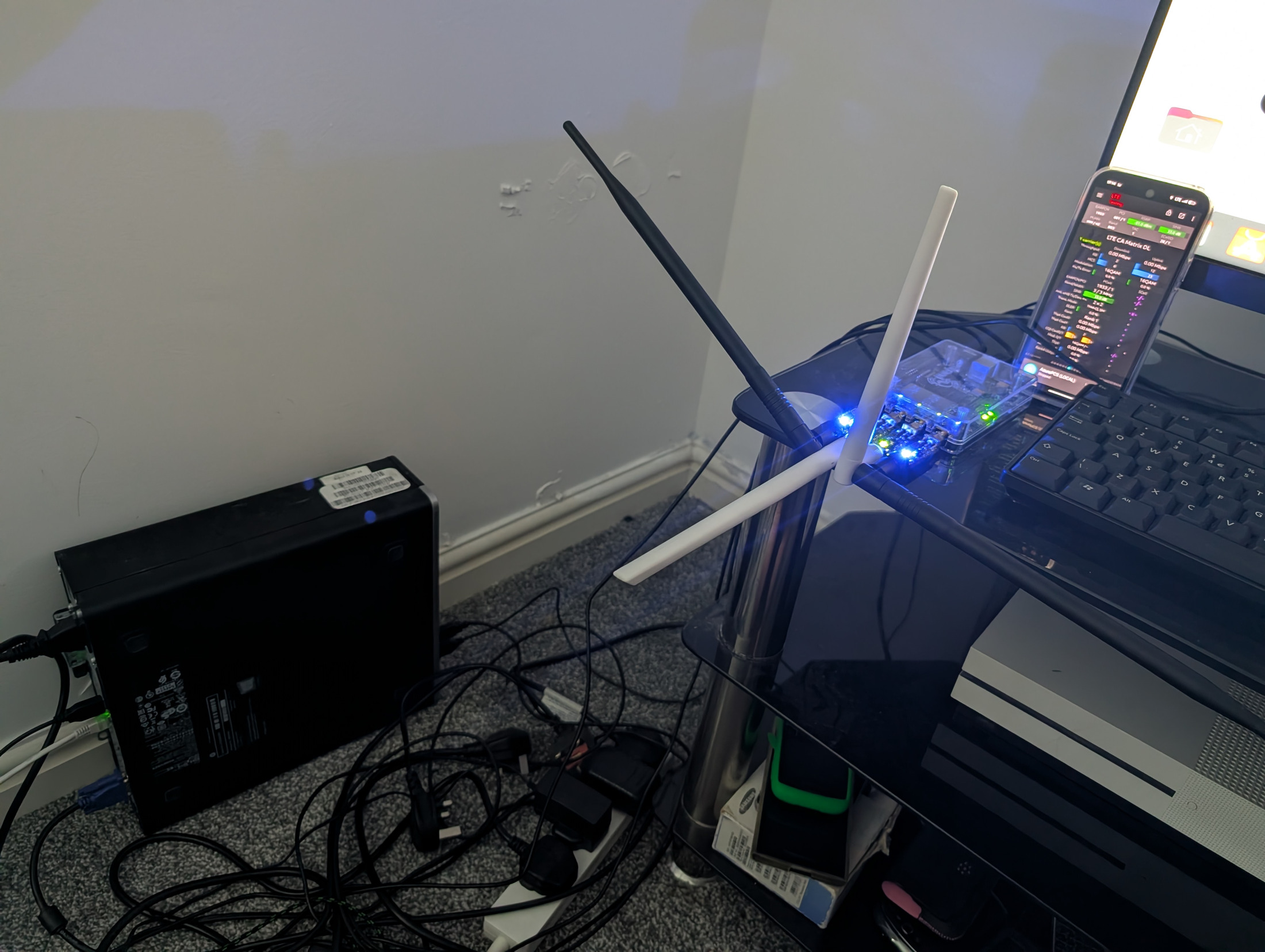
The home setup behind AzurePCS
My BladeRF, antennas and home PC during the early AzurePCS work. The mobile core ran on that PC while I learned how to bring the radio and the rest of the network together.
View full-size home setup photograph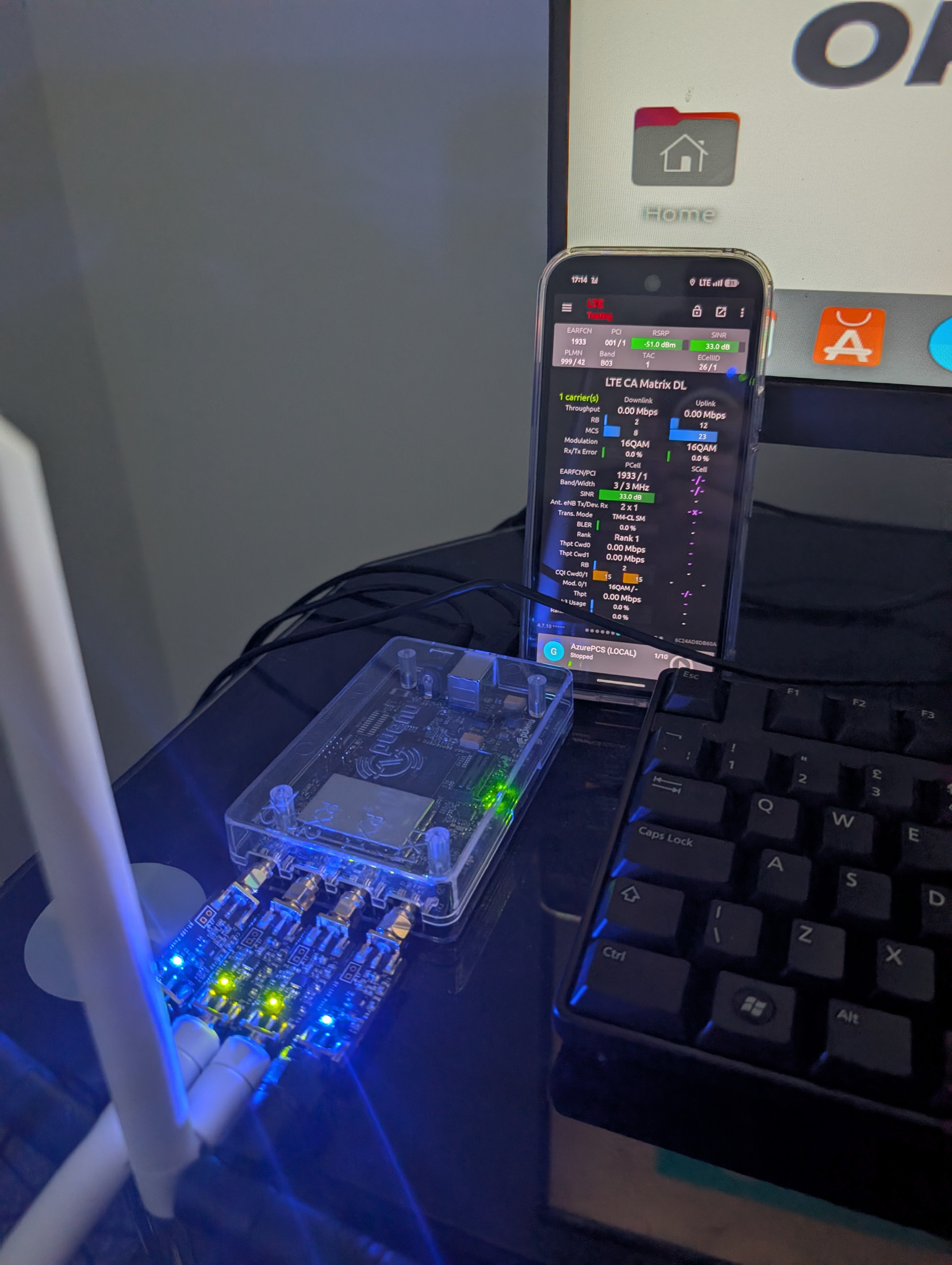
A closer look at the BladeRF
My BladeRF radio, antennas and test handset. The phone’s diagnostic display helped me see what was happening on the Band 3 radio connection.
View full-size BladeRF photograph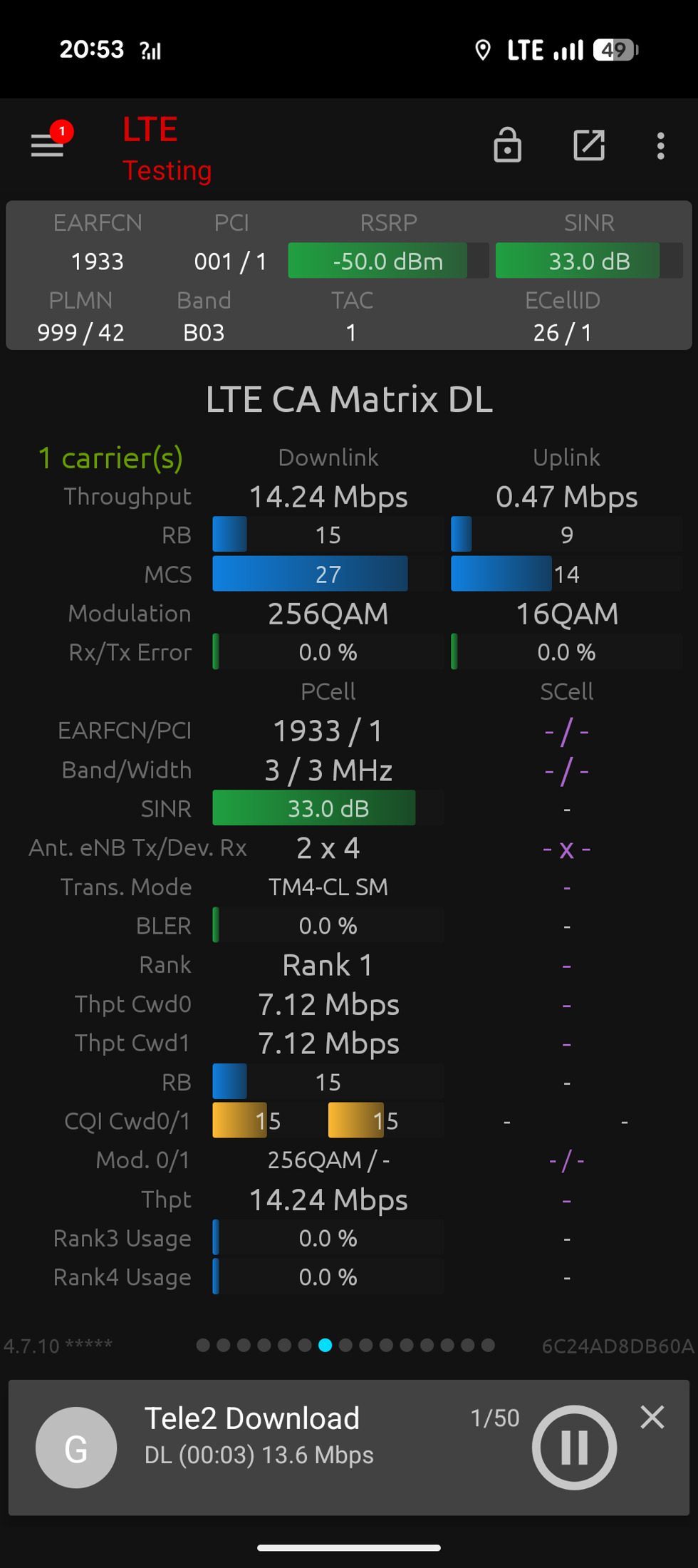
Looking inside the radio connection
The phone’s diagnostic view shows LTE Band 3 with a 3 MHz carrier during an AzurePCS test. The 99942 test PLMN shown here is part of that early setup.
View full-size Band 3 diagnostic screenshot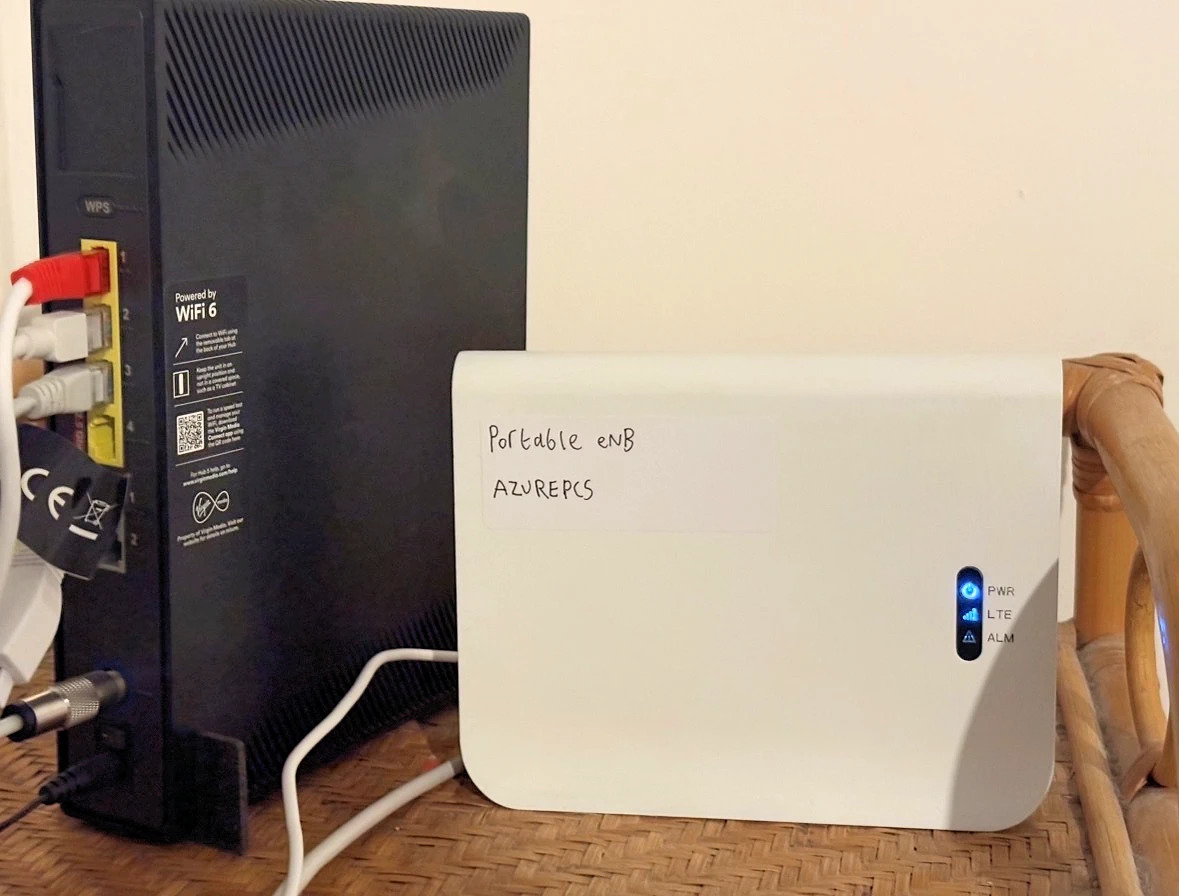
My portable LTE setup
My AzurePCS portable eNB beside a broadband router. The eNB is the LTE base station that gives a phone its local radio connection.
View full-size LTE setup photographSeeing AzurePCS on different handsets
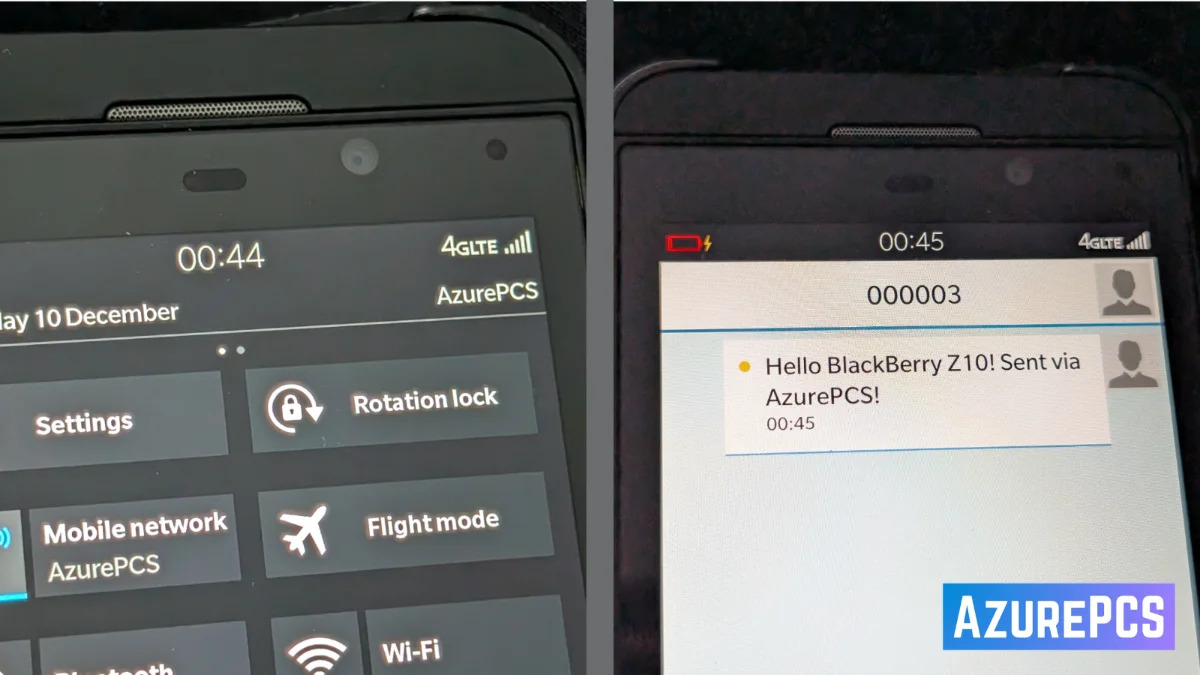
AzurePCS on a BlackBerry
A BlackBerry showing the AzurePCS network name and a test message. Getting a handset connected and seeing a message on the screen made the work feel real.
View full-size BlackBerry photograph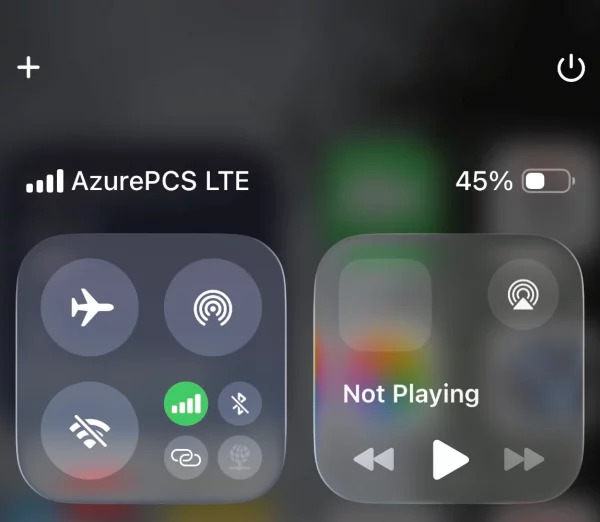
Another phone on AzurePCS
An iPhone showing AzurePCS LTE in Control Centre. Each different handset was another chance to learn how devices behaved with the network I was building.
View full-size iPhone screenshot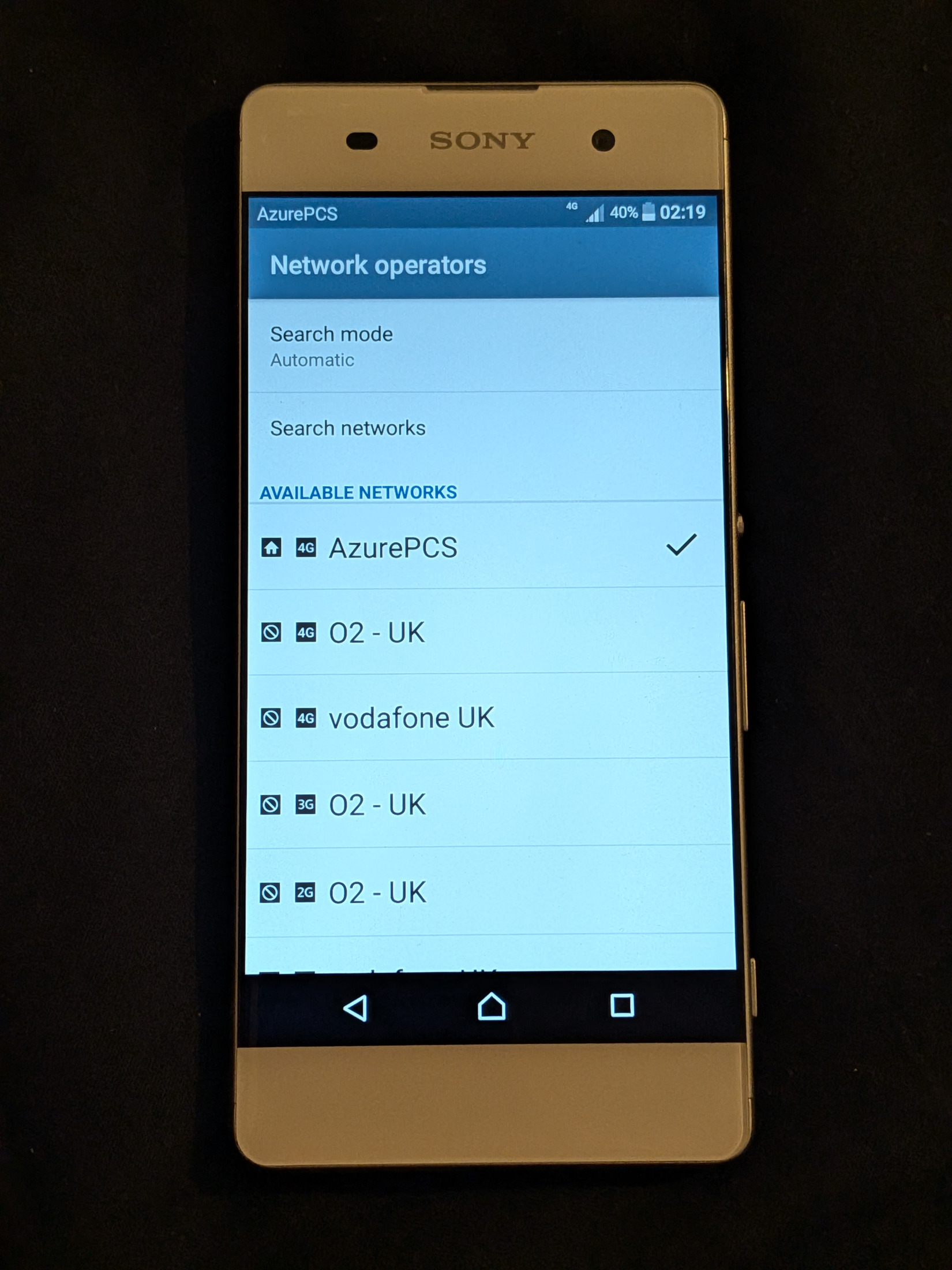
Finding AzurePCS in the network list
A Sony handset with AzurePCS selected in its 4G network list. Seeing the network I had built appear in that list was another moment that made the project feel real.
View full-size Sony network selection photographA short chapter in 2G
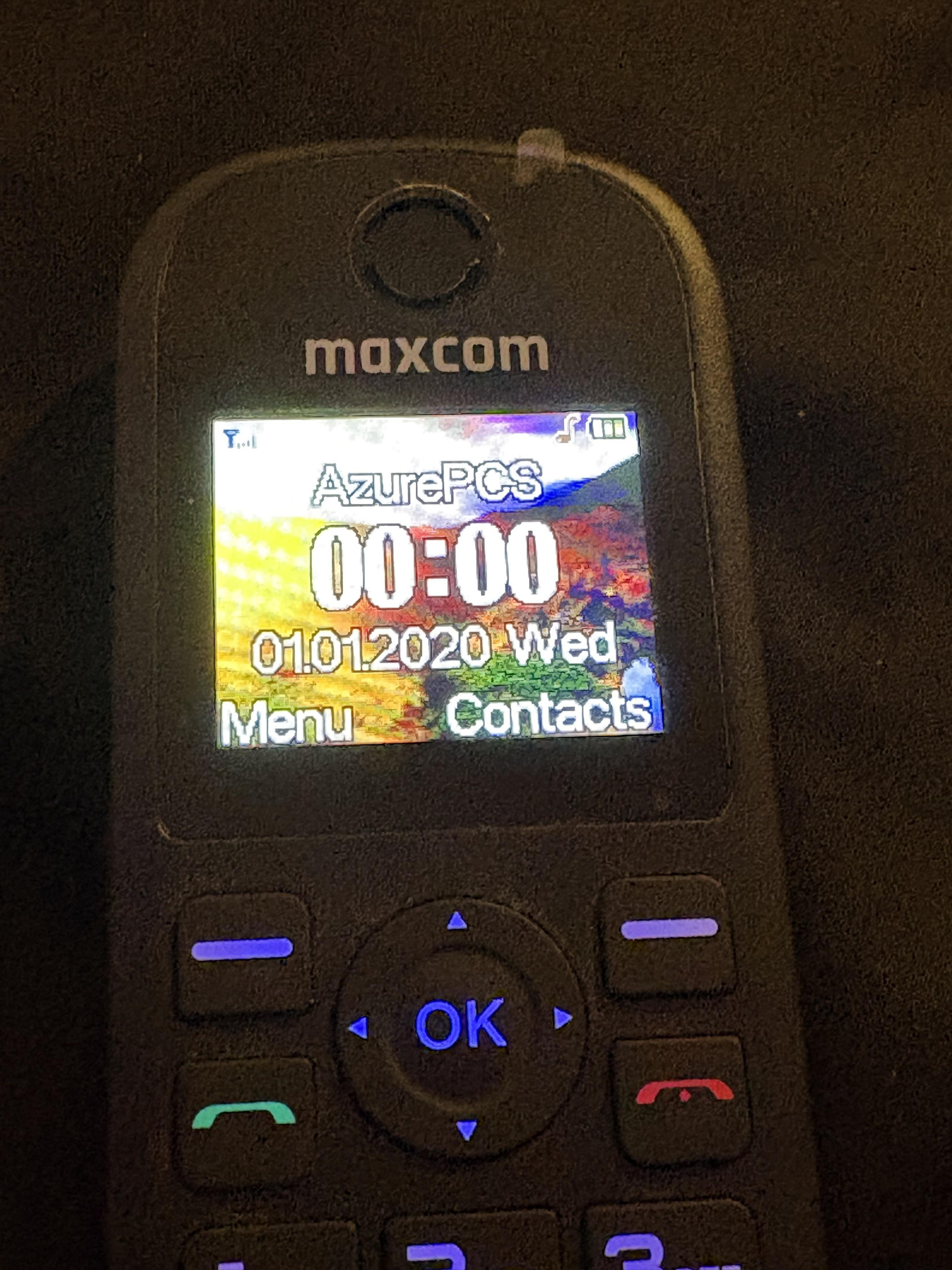
The brief 2G experiment
A Maxcom handset displaying AzurePCS during my short experiment with a NanoBTS. I no longer run or use that 2G setup.
View full-size 2G handset photograph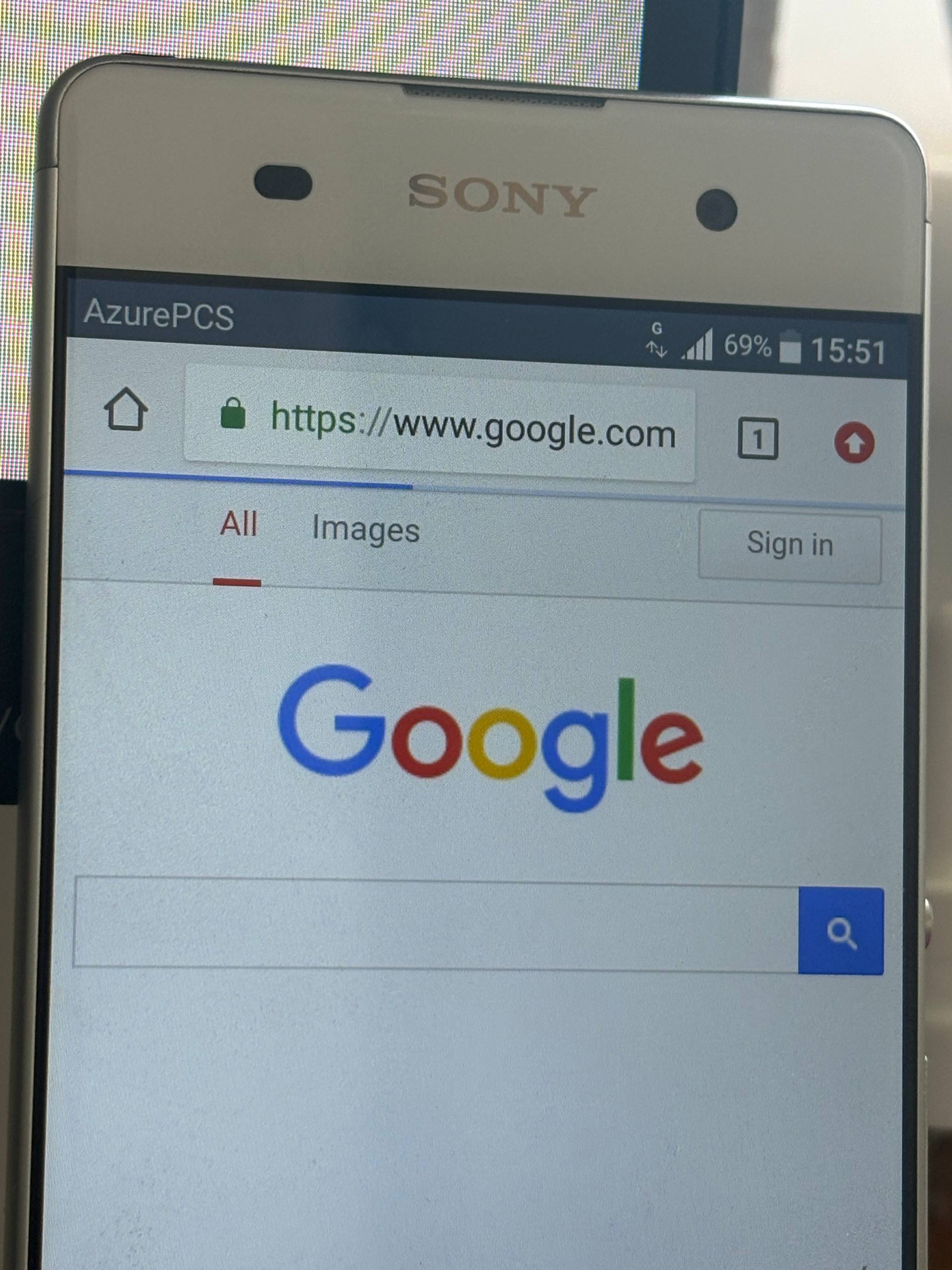
Browsing over GPRS
A Sony handset loading Google over GPRS during my short 2G experiment. It was another way to test that data could travel beyond the radio connection.
View full-size Sony GPRS photographMessages reaching another network
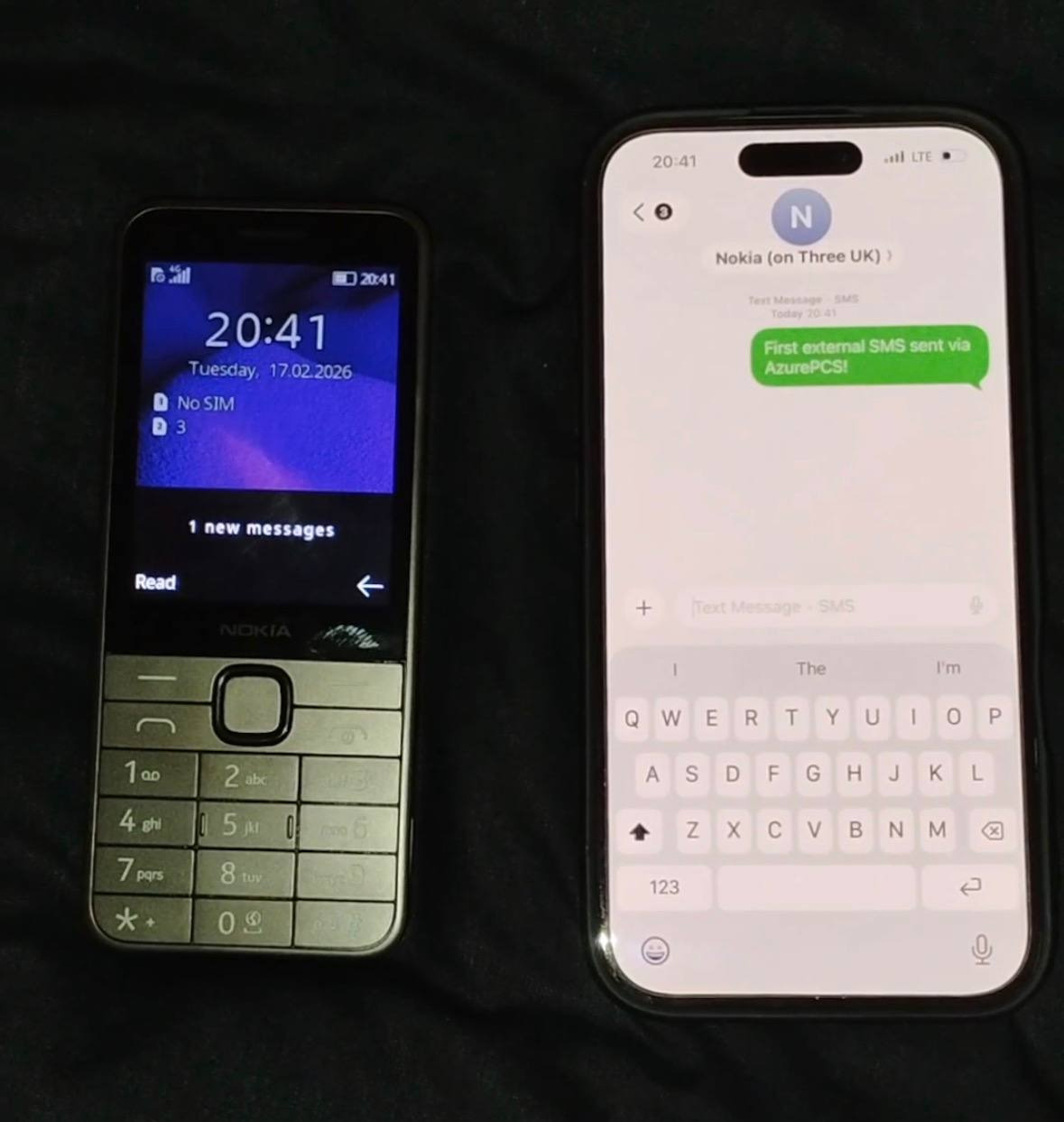
My first external SMS
The Nokia and iPhone mark the moment I got external SMS working through AzurePCS. After all the setup and troubleshooting, a message reaching another network was a real milestone for me.
View full-size external SMS milestone photographTesting the data connection
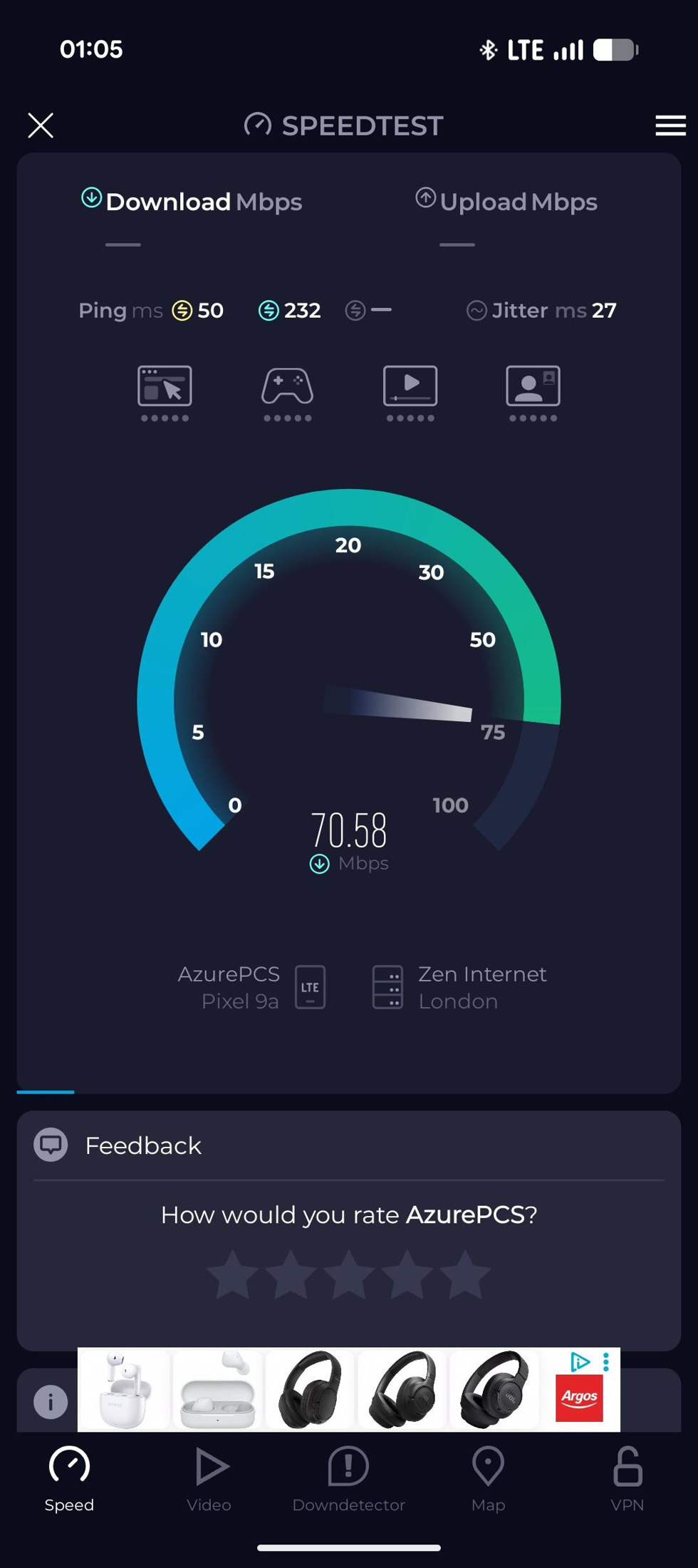
Trying the data connection
A Speedtest run in progress on AzurePCS, using Zen Internet in London as the test server. The dial shows a live reading during the test.
View full-size Speedtest screenshotConnectivity with a purpose
I started Lodestar because connectivity should be affordable, useful and something communities can help shape.
Different ways to get connected
Our public IP service works over an existing Internet connection. Our mobile project brings radio coverage closer to local people. Our voice platform adds familiar telephone services over IP. They serve different needs, but share the foundations I have been building.
Affordable for the long term
Keeping prices low means understanding the real costs: transit, hosting, addresses, equipment, licences, power and maintenance. I want growth to make the network stronger and spread those costs. Automation helps me spend less time repeating routine tasks and more time improving service.
Reliability takes daily care
There is no single switch that makes a network reliable. It comes from understanding failures, watching the right measurements and making changes carefully. We are preparing extra servers and additional mobile cores so that the next stage of Lodestar has better recovery options.
Sharing the knowledge
I want people to understand what they are using. A route, a radio bearer or a registration message can sound intimidating until someone explains its job. Making those ideas understandable is part of the project. What I learn here should make the next community network easier to build.
We want to change telecoms for good
More people should be able to understand the networks they use, help shape them and build something of their own. I want Lodestar to make that possible.
This matters deeply to me. I want us to pull it off: affordable connections, reliable services and a way into telecoms that people can actually enjoy. Every working cell, every useful service and every person who learns to build takes us closer to that change.
Some established ISPs may not like our plans. Some people who doubted me may not like seeing them happen. That will not decide what Lodestar becomes. I will keep building, improving the network and sharing what I learn. The people who need a connection and the people who want a chance to learn are the reason I am doing this.
The change I want is practical. A community should be able to understand its options, learn the technology and build useful infrastructure. Someone opening a guide for the first time should find a clear explanation and a way forward. That is the kind of telecoms industry I want to help create, and I am putting everything I can into making it real.
Where the network stands
Lodestar now runs across three servers in London, with a fourth coming soon, alongside our public IP service, full VoLTE, SMS over IP and an Ookla Speedtest server.
- 4G
- Our mobile core
- VOICE
- VoLTE, SMS over IP and Lodestar Voice
- IP
- Our public address service
- L2TP
- Open to order
- Mobile
- Local coverage, wider rollout ahead
- Mobile voice
- Full VoLTE and SMS over IP
- Lodestar Voice
- Preparing for public ordering
A working foundation
AS218388 joins our public address ranges to the Internet. Behind it are our mobile core, security gateway, IMS, subscriber systems, provisioning and monitoring. The three London servers give those systems a dedicated home. Our IMS supports full VoLTE and SMS over IP, bringing call signalling, telephone applications, media and messaging together.
The next stage
We are preparing extra servers and mobile cores to improve reliability. Our first macro style site is planned for Nuneaton, providing free local 4G during a pilot. I want to keep growing our L2TP service, build regional coverage across the West Midlands and work towards some form of national roaming. We are also looking at the broadband market and exploring our options. Public case studies will share the practical lessons.
One network, several journeys
A mobile connection brings together several systems. Each has a clear job, from the local radio link to the public Internet.
MOBILE
- LTE handset
Uses local radio coverage
- Radio and backhaul
Protected site transport
- 4G core
Controls and carries data
PUBLIC IP
- Your router
Uses an existing connection
- Your Internet provider
Carries the customer tunnel
- Our IP gateway
Routes your public IPv4
Follow the connection
The phone reaches a nearby radio. Protected backhaul carries that radio connection to our security gateway and mobile core. The core checks the subscription, creates a data session and tells the forwarding functions where packets should go.
Choose the service
Internet traffic leaves through our routing edge under AS218388. Voice registration and calls use the IMS service layer. A public IP tunnel takes another entrance: the customer connects over an existing Internet line to our tunnel gateway. All three journeys share parts of Lodestar while serving different needs.
Explore the whole story
Internet identity
Our ASN and public address space give Lodestar a place on the Internet. This is how we join the wider network.
Read this chapter03Public IP and L2TP
Keep the connection you already have and follow the tunnel, gateway and routing work behind our L2TP service.
Read this chapter04The mobile core
A radio site is where people meet the network. Protected transport and our mobile core turn a signal into connectivity.
Read this chapter05Voice and messaging
Full VoLTE, SMS over IP and Lodestar Voice, with the registrations, call routing, audio and applications behind them.
Read this chapter06Work and reliability
Every improvement behind the scenes has a purpose: making the service more useful, easier to run and stronger as it grows.
Read this chapter07Community networks
Full guides, a welcoming place to learn and the confidence to build a network for your own community.
Read this chapter08Our next chapter
Continued L2TP growth, exploring the broadband market, our Nuneaton pilot and a wider West Midlands ambition.
Read this chapter09Understanding faults
A connection is easier to understand when you follow its layers. Start with the symptom, then find the path that produces it.
Read this chapter10Terms and reading
Plain-English explanations of the terms in our story, with further reading for anyone who wants to build on it.
Read this chapter
This is only the beginning.
I have spent months building Lodestar, and I am proud of how far it has come. There is still so much I want to do.
I want to keep growing our L2TP service, strengthen the platform and bring our Nuneaton pilot and wider mobile plans to life. We are also exploring the broadband market and where we could make a difference.
I will keep working to make connectivity affordable, make the network stronger and help other people build something useful for their own communities. Thank you for being part of that journey.
Affordable connections. Stronger communities.
I want more people to have the chance to connect, learn and build.
Blake Williams
Founder, Lodestar Networks